
You Don’t Need a Guru!
You don’t need a guru. You need the truth.
And the truth is:
You have the power.
You have always had the power.
For more than a century, people have been told that changing the way they think can change their lives.
Think positively. Visualize what you want. Repeat affirmations. Program your subconscious. Set your intention. Manifest your future.
The names change. The teachers change. The promises change.
But underneath them is an idea that has survived for generations.
I wrote 1923: The Year America Discovered the Power of the Mind because I wanted to find the truth behind that idea.
Where did it come from? Why has it survived? Why can some of these methods work? Where do their promises go too far?
And perhaps most importantly:
Can you understand the principles well enough to use them yourself?
Because once you do, you don’t need a guru.
Why You Don’t Need a Guru
The story took me back more than a century to a pharmacy in France and a pharmacist named Émile Coué.
A woman came into Coué’s pharmacy asking for medicine he could not give her. Eventually, according to the story, he gave her a harmless substitute.
She left believing she had received something that would help her.
Later, she returned reporting that she felt better.
Coué knew what was in the bottle.
What fascinated him was what might have happened inside the woman.
Could her expectation have played a part?
One woman and one bottle couldn’t prove that. But the question stayed with Coué.
Eventually, it helped lead him toward a method known as autosuggestion and one of the most famous sentences in the history of positive thinking:
“Every day, in every way, I am getting better and better.”
The sentence became famous.
But the more important idea was underneath it.
Expectation matters.
You Don’t Need a Guru to Change Your Expectations
Think about what happens when you expect something.
Expectation affects attention.
If you expect failure, you may notice every obstacle in your path while overlooking opportunities.
If you believe improvement is possible, you may notice possibilities you previously ignored.
That doesn’t mean thinking something makes it happen.
It means thinking can affect the person who must deal with what happens.
That’s an important distinction.
Coué also recognized the strange relationship between willpower and imagination.
Tell yourself, I must not be nervous.
What are you thinking about?
Being nervous.
Tell yourself, I must not fail.
What image have you just placed in your imagination?
Failure.
Sometimes trying harder simply makes us concentrate more intensely on the very thing we’re trying to avoid.
Instead of fighting imagination, Coué believed we could give it another direction.
That principle is still with us.
We just keep giving it new names.
How a Simple Idea Became an Industry
Coué came to America in 1923.
People packed halls to hear him. Newspapers followed him. Doctors and critics challenged his ideas.
For a time, Émile Coué was a phenomenon.
Then something remarkable happened.
The man disappeared. The idea didn’t.
It kept traveling.
Florence Scovel Shinn gave it a spiritual voice.
Napoleon Hill connected thought with ambition and achievement.
Norman Vincent Peale brought positive thinking to millions.
Dale Carnegie emphasized confidence, action, and dealing effectively with other people.
Then came recordings, television, seminars, and bestseller lists.
Eventually, we arrived at today’s world of affirmations, visualization, subconscious programming and manifestation.
Different teachers.
Different terminology.
Different promises.
But when you know the history, you begin to recognize the same current running underneath many of them.
And that’s one reason you don’t need a guru.
You can learn to recognize the machinery.
You Don’t Need a Guru to Understand Why It Works
This is where the history becomes useful.
Your thoughts don’t have to magically control the universe to have an enormous influence on you.
The words you repeatedly tell yourself can influence what you expect.
What you expect can influence what you notice.
What you notice can influence what you attempt.
What you attempt influences what you do.
And what you repeatedly do can influence what happens next.
The chain is surprisingly simple:
Thought → Person → Behavior → Possible Outcome
Notice that final word.
Possible.
Not certain.
Not guaranteed.
That’s part of the truth too.
Reality gets a vote.
Circumstances matter. Other people matter. Health matters. Economics matter. Luck matters. Things happen that are completely beyond our control.
But reality getting a vote doesn’t mean it gets the only vote.
You get one too.
The mind does not have to control reality to help change reality.
The Truth the Gurus Can’t Own
This may be the most important thing I discovered while writing 1923.
Nobody owns this.
Nobody owns your imagination.
Nobody owns your expectations.
Nobody owns the words you say to yourself.
Nobody owns your ability to choose your response.
And nobody owns your next action.
That’s the truth the gurus can’t own.
You can choose the thought.
You can repeat it.
You can give your imagination another direction.
You can change what you expect.
You can become more alert to possibilities you might otherwise overlook.
You can act.
You can persist.
And when something doesn’t work, you can adjust and try again.
None of that gives you absolute control over life.
But you don’t need absolute control to change your life.
You Don’t Need a Guru—You Need to Understand the Idea
This is the promise behind 1923.
When you know the story, you begin to understand why these methods can work.
You also begin to recognize where the promises go too far.
You don’t have to throw away positive thinking because someone exaggerated it.
You don’t have to reject affirmations because someone promised that repeating the right sentence would guarantee wealth.
You don’t have to believe your thoughts command the universe to recognize that your thoughts can influence you.
Strip away more than a century of packaging, and what remains?
Expectation.
Attention.
Imagination.
Self-talk.
Repetition.
Behavior.
These are not secrets available only to an enlightened few.
They’re already yours.
The real secret isn’t another technique.
It’s understanding the machinery well enough to operate it yourself.
You Don’t Need a Guru. You Need the Truth.
That’s why I wrote 1923: The Year America Discovered the Power of the Mind.
I didn’t want to write another pep talk with a new jacket.
I wanted to go backward.
Past manifestation.
Past visualization.
Past positive thinking.
Past the affirmations.
Past the gurus.
Back to the people and ideas that helped create the modern belief in the power of the mind.
And ultimately, back to a woman, a pharmacist, and a bottle.
What was actually in the bottle?
Maybe that’s the wrong question.
Perhaps the more important question is what was happening in the person holding it.
Expectation.
Imagination.
Attention.
Belief.
And eventually, action.
Perhaps the next evolution of self-help isn’t another guru with another secret.
Perhaps it’s understanding why some of these ideas can work, recognizing their limits, and learning to use the underlying principles for yourself.
You don’t need a guru.
You need the truth.
And the truth is:
You have the power.
You have always had the power.
Now you can understand how to use it.
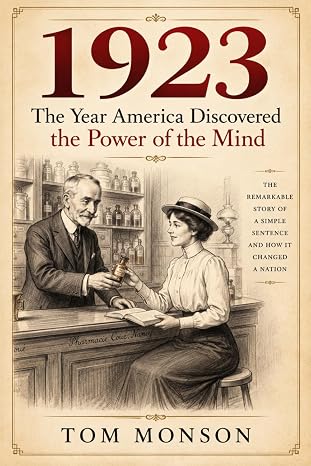
1923: The Year America Discovered the Power of the Mind tells the remarkable story behind positive thinking, autosuggestion, affirmations, visualization, and manifestation—and explores what may actually be working underneath them.
You may also like The Teachings of Florence Scovel Shinn and The Book of Affirmations