Your Community or Neighborhood Watch Program Guide
Empower your team and community to create safer neighborhoods. The Community Watch Administration Manual is your Neighborhood Watch Program Guide – the ultimate resource for law enforcement leaders, community organizers, and volunteers. This guide provides step-by-step instructions to plan, launch, and sustain effective crime prevention programs.
Whether you’re a police chief, crime prevention officer, block captain, or city official, this guide equips you with the tools to build trust, reduce crime, and strengthen your community.
The Problem: Crime and Disconnected Communities
Crime thrives where trust is low and communities lack organization. Law enforcement can’t do it alone. Without a clear plan, neighborhoods struggle to mobilize, and crime prevention efforts fall short.
The Solution: A Proven Neighborhood Watch Program
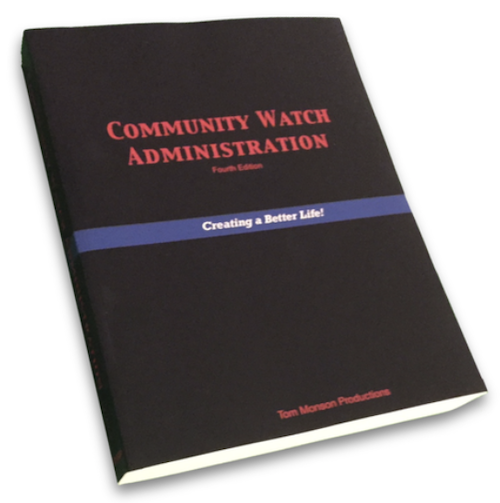
The Neighborhood Watch Program Guide bridges the gap between law enforcement and communities. It provides a clear roadmap to:
Manage programs in urban, suburban, and rural areas.
Build trust between police and residents.
Organize volunteers and keep them engaged.
Train community members to recognize and report suspicious activity.
Implement crime prevention strategies like CPTED and Operation ID.
This guide is designed for people working together. It helps law enforcement and community leaders create safer neighborhoods.
What’s Inside the Community/Neighborhood Watch Program Guide
This comprehensive guide includes everything you need to succeed:
- Step-by-step instructions for planning, launching, and managing a Neighborhood Watch.
- Ready-to-use forms for meetings, volunteer applications, and home security surveys.
- Training programs on personal safety, fraud prevention, and active shooter response.
- Management charts tailored to communities of all sizes.
- Publicity tips to grow awareness and support.
- Evaluation tools to measure success and prove impact.
Why Law Enforcement and Leaders Trust This Guide
The Neighborhood Watch Program Guide is built on proven strategies used by law enforcement and community leaders nationwide. It’s practical, easy to follow, and adaptable to any community.
Law enforcement agencies, city officials, and volunteers have used this guide to:
- Reduce crime rates.
- Strengthen community-police relationships.
- Empower residents to take ownership of their neighborhoods.
FAQs about the Neighborhood Watch Program Guide
Who is this guide for?
It’s for law enforcement leaders, crime prevention staff, community organizers, block captains, city officials, and volunteers.
Does it work for all community sizes?
Yes! The guide includes management structures for urban, suburban, and rural areas.
What topics does it cover?
Everything from leadership and volunteer management to home security, fraud prevention, and disaster preparedness.
Can I use this guide for training?
Absolutely. It includes ready-to-teach programs and materials for training volunteers and community members.
Get Your Neighborhood Watch Program Guide, Today
Don’t wait for crime to take over. Equip your team with the Neighborhood Watch Program Guide and start building safer, stronger neighborhoods today.
This guide gives you the tools, knowledge, and confidence to make a real difference.
Order your copy now and take the first step toward a safer community.
Available at book sellers and Amazon

Synopsis: Community Watch Administration Manual (4th Edition) – Neighborhood Watch Program Guide
What it is
A complete, practical manual to start and sustain Community/Neighborhood Watch.
Built for both police and citizens. It treats safety as a team sport.
Step‑by‑step playbook with forms, scripts, charts, and ready‑to‑teach programs.
Who it’s for
- Law enforcement leaders, crime prevention staff, and community‑policing units.
- Community organizers, block captains, homeowners, renters, and business owners.
- City and county officials, schools, faith groups, and service clubs.
- Trainers and volunteers, from teens to seniors.
What you learn
- Basics. What Community Watch is, why proactive beats reactive, and how to build trust.
- Leadership. Traits that move people. How to communicate, decide, and keep faith when it’s hard.
- Planning. Set goals. Form a Steering Committee. Survey the community. Use a clear flow chart.
- Communications. Control the narrative with meetings, newsletters, media, email, and WhatsApp.
- Management. Choose a structure for any city size. Define roles for Program Coordinator, District Coordinator, and In‑Group Leaders.
- Volunteers. Recruit, screen, train, and protect against burnout. Put seniors and teens to work with purpose.
- Implementation. Launch in urban, suburban, rural, marina, and airport settings. Use checklists, agendas, and block maps.
- Meetings. Run tight, useful sessions. Keep people engaged. Build skills in blocks and districts.
- Programs. Ready‑to‑teach lessons on home security, reporting suspicious activity, Operation ID, personal safety, sexual assault, child safety, fraud, auto theft, identity theft, internet safety, rural crime, CPTED, active shooter, and more.
- Homeland security and disasters. Spot signs, report well, and prepare your family and neighborhood. Includes chemical, biological, and radiological guides.
- Motivation. Keep momentum high with goals, recognition, and events like National Night Out.
- Promotion and publicity. Work with media. Write press releases. Speak in public. Grow awareness.
- Resource development. Raise funds. Build partnerships. Use cost‑benefit thinking.
- Evaluation. Survey well. Track results. Prove impact with data and dollars saved.
What’s inside the toolkit
- Management charts by population size.
- Job descriptions and training plans.
- Surveys, tabulations, and cost‑benefit templates.
- Block maps, phone trees, family info sheets.
- Home security surveys and household inventory.
- Volunteer applications and reference forms.
- Meeting flyers, door hangers, agendas, and sign applications.
- Sample press releases and award certificates.
Why it matters
Safer streets come from neighbors who look out for one another.
Trust grows when people share the work and the wins.
Budgets stretch when prevention lowers calls, losses, and fear.
Bottom line
This book gives you the structure, scripts, and tools to rally your neighbors, partner with police, and make crime a tougher choice on your block. It puts know‑how in the hands of the people. It’s clear, practical, and built to work in any community.
Contributors
Acknowledgements
This work is made possible by the dedicated professionals who are committed to making our world a better place. I would like to thank the following persons who shared the successful techniques they used to establish Community Watch, Neighborhood Watch, and other crime prevention programs in their jurisdictions. Their willingness to share what they have learned is truly appreciated.
- Sgt. Bill Farber, Alaska State Troopers
- Sheriff John T. Pierpont, Green County SO, MO
- Betsy Lindsey, Criminal Justice Consultant
- Tim Lytle and Shirley Peters, Medford PD, OR
- Peggy Tate, Tucson PD, AZ
- Lt. Madelyn Rakowski, Detroit PD, MI
- Lt. James Defoe, Bibb County Sheriff’s Office, GA
- Jan Sener, San Clemente PD, CA
- Dan Pantel, Stuart PD, Florida
- Karen Evans, Crime Prevention Assoc. of Oregon
- Johnny B. Johnson, Waukegan PD, IL Crime Prevention Resources
- Kelly Brauer, Glendale PD, AZ
- Capt. John Dunivan, Gaston County PD, NC
- Sgt. Martin J. Jacobson, Stuart PD, FL
- Dr. Gary P. Maddox, University of Missouri, MO
- Chief of Police, Daryl E. Pearson, Walla Walla PD, WA
- Jerrold G. Antoon, Chair, Fox Valley Technical College, WI
- Ed Temple, Jackson County SO, OR
- Branch Walton, U.S. Secret Service (Retired)
- Ofc. John Hanke, Joliet Police Dept, Joliet, IL
- Mark Howard, Seattle PD, WA
Consulting Editors:
- Jerrold G. Antoon, Chair, Criminology Dept. [Ret], Fox Valley Tech. College, Appleton, WI
- Sgt. Martin J. Jacobson [Ret], Training Commander, Stuart Police Department, Stuart, FL
- J. Branch Walton, US Secret Service [Ret], Security Services Int’, Columbus, IN
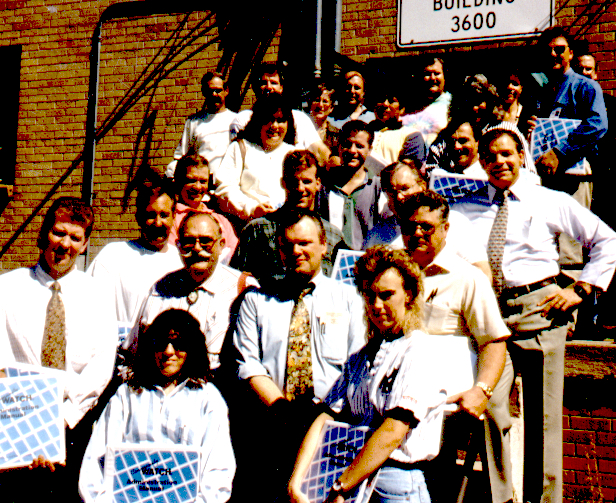
The above photograph is one of the graduating classes of the three-day Community Watch Administration class in 1995. Back then, the manuals were larger and produced in a three-ring binder.