
Effective Sales Management: The Timeless Truth About Leadership
There is a pervasive lie in modern business: that effective sales management must constantly reinvent itself because technology moves at breakneck speed. We’re told that because pipelines are now managed by algorithms, teams communicate across digital distances, and tools evolve daily, the very nature of sales leadership has to change with them.
That is a fundamental misunderstanding of the human condition.
Circumstances evolve. Tools change. But the core of sales leadership? It has not moved an inch since the dawn of human history.
Effective sales management requires true sales leadership, which is the absolute, unshakeable acceptance of responsibility for the success of the salespeople in your charge.
People Have Not Changed
People do not change. Their fears, deep-seated insecurities, burning ambitions, and crippling doubts remain the same across every decade. Salespeople don’t fail because the market shifts or because the technology is new. They fail because they are human beings — frozen by rejection, scattered by a lack of structure, or blinded by destructive internal self-talk.
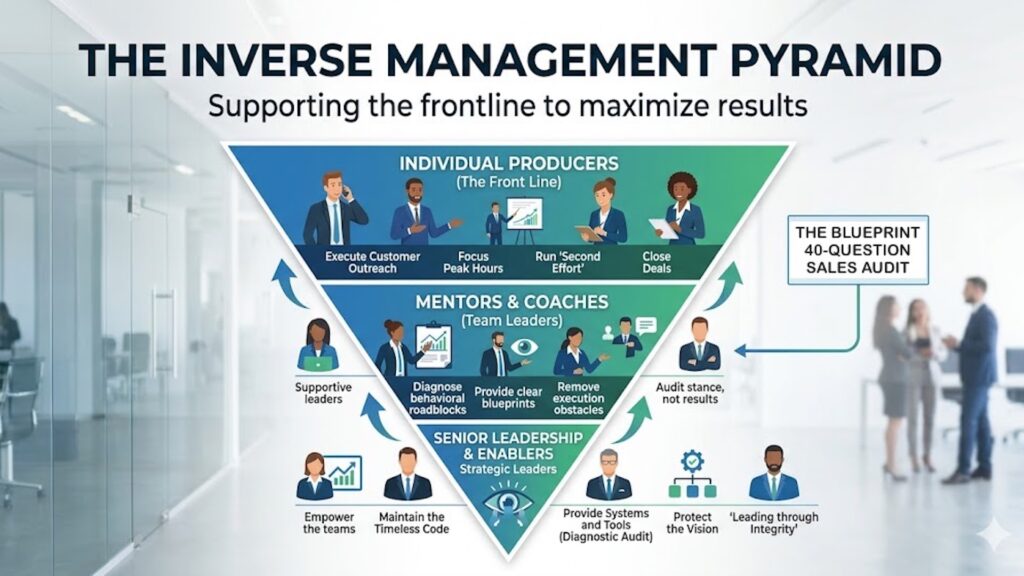
When I look back at my own journey — from a high school dropout sanding cars just to put food on the table, to an executive buying and selling corporations — I realize my salespeople never needed a “boss.” In my mind, “boss” is a bad word. A boss inspects results and tells people what to do. A leader provides the infrastructure, models the behavior, and creates the conditions that make winning possible. It’s the inverted-pyramid model where the leader supports the team from the bottom.
The system I teach today in my World-Class Sales Masterclass was not dreamed up in a corporate boardroom. Its origin was forged in a freezing winter in Spokane, Washington, when everything was on the line. But more importantly, it was built on a foundational lesson about integrity that I had to learn the hard way long before I ever managed a team.
They didn’t need another boss.
They needed a leader willing to carry the team on his shoulders.
Effective Sales Management, that’s where the turnaround began.
Part I: The Standard You Model: Effective Sales Management
Effective sales management dictates that you cannot credibly ask your sales team to take absolute personal responsibility for their territory until you have first demonstrated that you are willing to look honestly at your own reflection and take full ownership of your word.
Integrity is not a corporate slogan hanging on a wall or a feel-good value listed in the employee handbook. It is the ultimate competitive advantage in sales leadership. It quietly but powerfully sets the absolute ceiling for your team’s culture, trust, and long-term performance. When integrity is modeled from the top, it creates unshakable confidence throughout the organization. When it’s missing, everything eventually crumbles.
Early in my career, I witnessed firsthand what the empty promises of poor management looked like and how they ultimately destroyed not only a team’s performance, but the team itself. I saw talented people become cynical, disengaged, and eventually walk out the door because their leader’s words didn’t match their actions. The broken commitments, the shifting expectations, and the quiet compromises eroded trust so completely that even strong producers began to doubt the mission.
That experience cut deep. It taught me that leadership isn’t about demanding results from others while protecting yourself. It’s about going first — holding yourself to the highest standard, so your team has something real to follow.
This wasn’t just a personal lesson. It became the non-negotiable standard I carried into every leadership role from that day forward.
Part II: The Clock in Spokane
The Spokane winter of 1983 was unyielding, grey, and bitterly cold. The regional Yellow Pages directory was severely behind schedule. In that industry, the calendar was an absolute dictator. If the sales team failed to close their accounts on time, the printing presses would stop, distribution would fail, the corporation would lose millions in recurring revenue, and heads would roll — starting with mine.
I had been given the Regional Manager role because I was a top individual producer. I knew how to sell cleaner and faster than almost anyone. But now the president wasn’t asking me to produce sales. He was asking me to rescue a team of twenty-five salespeople who were on the brink of total collapse.
The First Day
I walked into that conference room and saw good, honest, hard-working people who were completely overwhelmed — running on a treadmill moving faster than their legs could carry them. My eyes quickly locked onto five reps who represented the crux of the territory. If I lost them, I lost the book.
- Judy was exceptionally talented, but her numbers were cratering. She was trapped in constant self-doubt, paralyzed by the fear of approaching large corporate accounts.
- Dan was relentless with activity but emotionally raw — one harsh rejection in the morning would destroy his focus for the entire day.
- Lloyd had immense product knowledge but zero professional presence. He showed up to meetings disheveled, with scuffed shoes and wrinkled shirts, unaware that his appearance was destroying buyer confidence.
- Doug was a natural charmer who could build instant rapport, but he was completely unstructured. His appointments were scattered across the city, and every Monday felt like starting over from zero.
- Dave was my rising star with unlimited potential, but his fundamentals were dangerous. He worked himself to exhaustion, arriving early and staying late, yet still barely scratching his quota while standing on the edge of burnout.
At first, I did what most new managers do when terrified of failing: I hid behind authority. I inspected call logs, ran high-pressure meetings, reviewed numbers, and tried to motivate them with loud pep talks.
Nothing changed. The numbers stayed flat as the deadline raced closer.
I realized I was focusing entirely on the scoreboard instead of the stance and the swing. In effective sales management, a leader cannot dictate results through conscious pressure alone. I had to take personal responsibility for their lack of clarity. So I threw out the traditional management playbook and sat down with each rep individually.
Part III: Engineering the Blueprints: Effective Sales Management
The discovery interviews revealed a stunning truth: Every rep was suffering from a completely different structural bottleneck. They didn’t need a boss telling them to work harder. They needed a mentor to give them specific behavioral fixes.
Judy – Shifting the Internal Narrative
Judy asked me a heavy question: “Why did Willie Loman have to be a salesman?” Her issue was rooted in Arthur Miller’s Death of a Salesman. After a lengthy discussion, I discovered she saw sales as a profession for those who couldn’t find a real job rather than a proud profession.
I introduced her to Clear Internal Instructions. She handwrote her specific value targets on a physical card every morning and used positive mental imagery. We shifted her identity from “beggar” to “elite marketing consultant delivering a lifeline to local businesses.” Once her internal instructions changed, her execution followed. Her closing ratio doubled in weeks. What I taught her became the foundation of my Winning Mindset module.
Dan – The Mechanics of Resilience
Dan confessed that a single blunt rejection would linger for days. I taught him: “We don’t need their business. They have far more to gain from our solution than we do from their commission.”
I installed the Second Effort framework. He was instructed to treat “no” as operational data, wait four days, reset mentally, and execute a respectful follow-up. Rejection became mechanical instead of emotional. Dan transformed into the team’s top follow-up machine. This is the heart of the Unshakable module.
Lloyd – Unlocking the Professional Edge
I pointed directly at Lloyd’s scuffed shoes: “Buyers feel your certainty and respect your presence long before they process your data.”
We worked on stance, greeting, vocal tone, and presentation materials. By projecting authority through body language, Lloyd built immediate buyer confidence and became one of the most trusted closers in the region. What I taught him became the Professional Edge module.
Doug – The Architecture of the Day
Doug lived in administrative chaos. I anchored him to The Power of the Plan. He started every day by handwriting his top targets on a 3×5 index card. We blocked protected morning Power Hours for prospecting and geocoded his appointments to eliminate wasted travel. By learning the right structure, Doug finally hit quota consistently and became the #1 salesperson in the entire region.
Dave – Building Sustainable Mastery
Dave was burning out. I gave him the full integrated system: the 80/20 listening rule, structured questioning to let buyers discover their own pain, and sustainable daily rhythms. He stopped pushing features and started truly listening. Dave transformed into a consistent top producer without destroying himself.
Part IV: Why I Developed the Tools of Effective Sales Management
That winter taught me a painful truth: It took months of observation to identify what should have taken minutes.
That is exactly why I developed the Sales Performance Index — a 40-question predictive assessment that gives sales leaders an immediate, objective diagnosis of each salesperson’s strengths and gaps.
It functions like an MRI for your territory. In just 7 minutes, you can pinpoint the weakest module and deliver a precise coaching prescription.
The Ultimate Responsibility of Effective Sales Management
If you are leading a sales team, stop hiding behind dashboards and treating your people like numbers. Your reps depend on you.
A boss demands results.
A true leader creates the environment, models the integrity, installs the tools, and hands them the precise blueprint they need to win.
Your people are waiting for real leadership.
Give it to them.
Learn about the Sales Performance Index HERE
This is the tool I wish I had during that winter in Spokane.
About Tom Monson
For more than 50 years, Tom Monson has helped organizations and individual salespeople achieve outstanding results. He has trained teams at Sony, Walmart, Macy’s, Dairy Queen, Subway, major police departments including Miami-Dade and Boston, and universities such as UCLA, the University of Illinois, and Portland State — along with hundreds of other companies and institutions.
A recipient of numerous awards for sales achievement, writing, and filmmaking, Tom brings hard-earned, battle-tested wisdom to every training.